11/19/2026 9:30:00 AM | Women's Volleyball
Like all collegiate student-athletes, Purdue Fort Wayne Lili Smith's volleyball career has been defined by hard work, dedication and a little bit of luck. But unlike most, she has the support of her Native American heritage behind her.
There are 652 Native American student-athletes at the Division I level, and Smith is one of them.
Smith, who is 6.25 percent Native American in the Pokagon Band of Potawatomi, grew up knowing she was part of the tribe, although she admits she didn't always understand the full extent of what that meant.
Her family's tribal heritage has remained an important part of its history, even as generations have moved farther away from the community.
The Pokagon Band of Potawatomi, officially established as a federally recognized tribe in 1994, provides a variety of resources for its members. Revenue generated through its enterprises, including the Four Winds Casinos, helps fund education, scholarships, health care, housing assistance, cultural preservation and tribal government services.
For Smith, those resources have played a significant role in her development, both as a student and an athlete.
Growing up, she benefited from educational grants, academic incentives and financial assistance for extracurricular activities. Those opportunities helped make experiences possible that might otherwise have been difficult for her family to afford.
The impact was particularly meaningful in volleyball.
Smith's mother was a single parent for much of her childhood, and the costs associated with competitive club volleyball, travel and college recruiting opportunities could add up quickly. As Smith progressed from a smaller local club to a larger program, those expenses increased.
Tribal assistance helped bridge the gap.
"Helping with travel costs and entry fees into playing travel, that definitely helped a ton," Smith said. "My mom tried to keep me on budget as much as she possibly could."
The funding also helped Smith attend college volleyball camps, giving her opportunities to explore playing at the next level.
"Being able to do that was definitely helpful," Smith said. "I think that's really cool."
That support extended beyond the volleyball court. Smith's family also benefited from the tribe's educational assistance, including her mother, who became a physical therapist after attending college while raising Smith.
Her mother had Smith at 21 while still working toward her degree. Without much financial support from her own parents, tribal resources helped provide a foundation for her education and, ultimately, her ability to provide for her daughter.
Smith sees that connection as one of the most meaningful parts of her family's story.
"I would say that's probably the biggest part," she said. "Having that help throughout helped obviously raise me and have a good life for me."
As Smith got older, her understanding of the tribe's support grew. Although her parents handled much of the paperwork when she was younger, her mother encouraged her to take a more active role during her senior year of high school.
That led Smith to discover the Pokagon Indiana Education (PIE) Fund, a tribal scholarship program that has helped cover her college expenses at Purdue Fort Wayne. The PIE Fund covers unmet costs at any Indiana public higher education institution, and with her aspirations to play college volleyball, Purdue Fort Wayne was the logical next step.
The financial assistance became even more significant once she began navigating college costs on her own. Smith said the tribe's support has helped cover expenses that otherwise would have fallen to her family, allowing her to put more money toward savings and other needs.
It has also sparked a greater interest in learning about her heritage.
Smith acknowledges that she hasn't had many opportunities to experience tribal life firsthand. Her family lives a considerable distance from the reservation, and while some of her older relatives were more involved in the community, she hasn't attended many of its gatherings or cultural events.
Still, she hopes to change that.
The Pokagon Band hosts summer powwows, community celebrations and regular gatherings, offering opportunities for members to reconnect with their culture and one another. Smith has followed some of those activities online and through information shared by her aunt, but would like to experience them in person.
"I would love to go," Smith said. "I would like to go down there and see everything that happens because I've never really seen anything about it."
Her relationship with her heritage has also evolved over time. As a child with blonde hair and blue eyes, Smith sometimes questioned how she fit into her Native American ancestry. Her mother, who more visibly reflects the family's heritage, helped keep that connection present through conversations and lessons along the way.
Eventually, Smith began to view it as something that made her unique in a positive way.
"When I was younger, my mom would kind of bring that up to me," Smith said. "It would kind of be fun facts for me. I'd be like, 'Oh, I'm Native American,' or 'I'm part of this tribe.'"
Now, as she continues her volleyball career at Purdue Fort Wayne, Smith recognizes that her connection to the Pokagon Band represents something much bigger than financial assistance. It is a family legacy, one that helped her mother pursue a college degree, helped Smith chase her athletic ambitions, and continues to support her as she pursues her degree in psychology.
She may still have much to learn about her heritage, but she understands the importance of the foundation it has provided.
"I want to learn a lot more than I have," Smith said. "It's endless. I won't ever know the full extent of it."
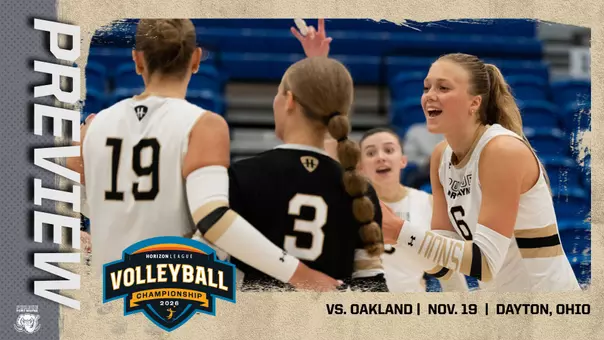
Smith and the Mastodons will play in the Horizon League Championship this week, first with a match against Oakland on Thursday afternoon (Nov. 19).
~ Feel the Rumble ~