Feature: Corey Hadnot II’s Path to Breakout Junior Season
2/24/2026 10:56:00 AM | Men's Basketball
For Corey Hadnot II, the decision to play at Purdue Fort Wayne came down to one simple truth: he hates losing.
Coming out of high school with ties to both Atlanta and Houston, the talented guard had several college options. But not all of them offered what he valued most — a chance to win.
“With the offers I had, they were good schools,” he said. “But they weren’t winning as much as I’d like. I don’t like to lose. Nobody likes to lose. I could potentially be a sore loser sometimes because of how much I hate losing.”
That competitive fire led him to the Mastodons, a program with a history of success under 12th-year coach Jon Coffman. However, the offensive system that Purdue Fort Wayne utilized was also attractive to Hadnot II.
“The guard's freedom,” Hadnot II said, explaining what stood out most. “(Purdue Fort Wayne) lets their guards create. Not do whatever they want, but they give them freedom and space to go to work. And I saw an opportunity to play with other really good players.”
That stylistic fit has paid off in a major way this season.
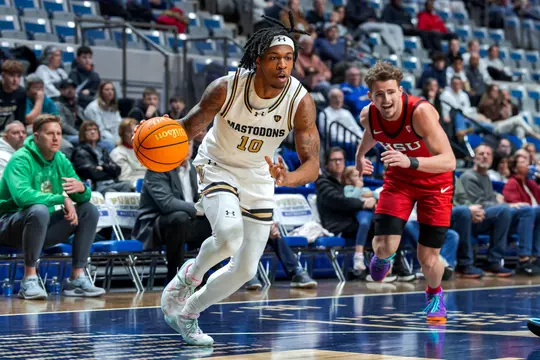
Hadnot II is averaging a league-best 20.6 points with 4.0 rebounds, 3.4 assists and 1.8 steals, which makes him one of three players in NCAA Division I men's basketball who average 20 points, 4.0 rebounds, 3.0 assists, and 1.5 steals—the others are Cameron Boozer—Duke & Nolan Minessale—St. Thomas.
“I saw this developing because Corey has been obsessed with player development since his recruitment,” Coffman said. “Corey and his family loved seeing how former Mastodons developed into professional players over their time in Fort Wayne.”
“Corey added 12-15 pounds of muscle this past year, which has turned him into a physical guard,” Coffman said. “And his efficiency has risen each year in our program because of his off-season work.”
As a freshman, Hadnot II shot 40.9 percent from the floor and averaged 6.2 points per game. Last season, his shooting jumped to 44.6 percent with 9.0 points per game. However, as “the guy,” in many ways, for the Mastodons this season, he is shooting a career-best 53.1 percent in addition to leading the league in scoring.
After the Mastodons lost two first team all-league guards from last year’s roster, Hadnot II stepped into a larger role this season and elevated his production, becoming one of the focal points of the offense. He attributes the jump not to luck, but to patience and preparation.
“Staying confident in what I do, knowing my time is going to come,” Hadnot II said. “As long as I put in the work — get in the gym, take the hours throughout the day to develop my game — everything is going to fall in place.”
Corey Hadnot II with the ???#FeelTheRumble #HLMBB pic.twitter.com/uO2Yu00azk
— Purdue Fort Wayne Mastodons Basketball (@MastodonMBB) February 22, 2026
That development has been fun to watch, not just for the Mastodon coaches and Hadnot II’s teammates, but for the Purdue Fort Wayne fans.
“It is cool to see Corey’s confidence grow,” Mastodon supporter and Fort Wayne businessman Jeff Davis said, “You see that on the court. You see his growth as a player. He has taken charge (of the team).”
Davis may be Hadnot II’s biggest fan.
The two bonded through the Mastodons’ community mentoring program, which pairs a Purdue Fort Wayne player with an adult mentor in the community. These mentor’s goal is to connect once a month and introduce them to other community leaders at these meetings to help develop a network within Fort Wayne to help set them up for life after basketball.
Davis, who works in the mortgage business, connects with Hadnot II regularly, takes him out for dinner on occasion and has had him over to his house to hang out with his kids, who are of a similar age to Hadnot II.
“I just try to make him feel normal,” Davis said. “You don’t have to be a Mastodon basketball player. You can just be a dude hanging out with other people your age. I think it’s helped him feel comfortable in Fort Wayne.”
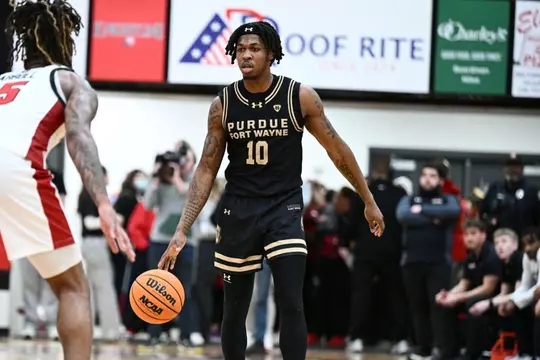
The Mastodons’ offensive philosophy has helped unlock Hadnot II’s game and feel comfortable with his future in Fort Wayne. Built on playing fast, spacing, cutting, and disciplined execution, the system creates room for guards to attack.
“We work on cutting a lot in practice,” Hadnot II said. “Some people might think it’s boring, but it helps during the game when it becomes a habit. You don’t jog your cuts — you sprint and get out of the way. That opens the paint so a guard can create for himself or others.”
With increased responsibility has come increased confidence. Hadnot II acknowledges that having a coaching staff who believes in him — drawing up plays and trusting him in big moments — has been a significant boost.
“It makes you feel invincible at times,” he said of his coaches’ confidence in him. “But being a leader comes with responsibilities.”
Leadership, he says, goes beyond scoring. It means defending the opponent’s best player, diving on the floor for loose balls, and encouraging teammates — even from the bench if foul trouble strikes.
“I have to be verbal,” Hadnot II said. “I encourage my teammates, get on them when they’re slacking. And I have to do it with my actions.”
Hadnot II’s comfort in that leadership role may stem from earlier decisions in his basketball journey.
He is originally from Atlanta, but moved to Houston during high school in what Hadnot II believes was a move centered around basketball. His parents sought a program with strong coaching and a winning reputation — but not one overloaded with talent.
“They wanted me somewhere I could build my legacy,” Hadnot II said.
The approach mirrors his college choice: a competitive program where he could grow into a featured role rather than blend into the background.
Basketball runs deep in his family. His mother played at Sinclair Community College in Ohio, and his father competed at UT Permian Basin. Postgame conversations at home can include both praise and pointed critiques.
“Parenting comes first,” Hadnot II said with a smile. “Then the coaching.”
Hadnot II is set to graduate this spring with a degree in general studies, and he is considering pursuing a master’s degree in communications. When his playing days eventually end — hopefully decades from now — he has thought about a career in broadcasting or sports analysis.
For now, though, his focus remains on winning — just as it was when he first chose Fort Wayne.
As his breakout season continues, Hadnot II’s belief in preparation, fit, and relentless competitiveness is proving to be the right formula.
Hadnot II’s athletic evolution is following a similar journey to other great players who have represented the program.
Players such as John Konchar (now with the Utah Jazz), Max Landis (2016 Summit League Player of the Year and former professional player), Jarred Godfrey (playing professionally in Europe), among others, each laid the foundation for a professional career through their time in Fort Wayne.
“The play style prepares you to play after college,” Landis said of the Mastodons. “And just dealing with different teammates from all walks of life has helped me be able to blend in with any team that I have been with.”
Over the last 15 seasons, the Purdue Fort Wayne men’s basketball program has produced 26 players (eight currently), who have gone on to the professional ranks athletically.
“If you can shoot it,” Landis said, “then you can play for Coach Coffman.”
And Hadnot II is coming off of 6-of-7 from three in Sunday’s Cleveland State win.
“I love coaching players who have circles pulling in the same direction as our coaches no matter what adversity strikes,” Coffman said. “And that is Corey and his mom. I am so proud of his development both on and off of the court. I love watching him command a crowd on his interviews—and think back to how shy he was as a freshman. His career has turned into gold in Fort Wayne, because he has worked-and-worked-and-worked.”
“And I give a ton of credit to community members like Jeff Davis who have made him comfortable in Fort Wayne,” Coffman continued. “I have no doubt that when basketball is over—like I advertise in recruiting—the Fort Wayne community will help him skip the first job for the second and he’ll be receiving the coffee in the meeting versus serving it.”
“But let’s don’t talk about after basketball just yet,” Coffman said. “Let’s enjoy him leading Fort Wayne’s team and stacking winning plays like he has done for the past three years.”